

Give reasons for the following: ‘
(a) Covalent bonds are directional bonds while ionic bonds are non- directional.
(b) Water molecule has bent structure whereas carbon dioxide molecule is linear.
(c) Ethyne molecule is linear.
(i) Since the covalent bond depends on the overlapping of orbitals between different orbitals, the geometry of the molecule is different. The orientation of overlap is different. The orientation of overlap is the factor responsible for their directional nature.
(ii) Due to presence of two lone pairs of electrons on oxygen atom in HiO the repulsion between Ip-lp is more. C02 undergoes sp hybridization resulting in linear shape (O = C = O) while H20 undergoes .sp3 hybridisation resulting in distorted tetrahedral or bent structure.

(iii) In ethyne molecule carbon undergoes sp hybridization with two unhybridised orbitals. One sp hybrid orbital of one carbon atom overlaps axially with sp hybrid orbital of the other carbon atom to form C – C sigma bond while the other hybridized orbital of each carbon atom overlaps axially with S orbitals of hydrogen atoms forming σ bonds. Unhybridised orbitals form Ï€ bonds


Elements X, Y and Z have 4, 5 and 7 valence electrons respectively, (i) Write the molecular formula of the compounds formed by these elements individually with hydrogen, (ii) Which of these compounds will have the highest dipole moment?
What is the effect of the following processes on the bond order in N-, and 02?
(i) N2 → N+2 + e– (ii) 02 → O+2 + e–
Briefly describe the valence bond theory of covalent bond formation by taking an example of hydrogen. How can you interpret energy changes taking place in the formation of dihydrogen?
Which of the following statements are correct about CO32- ?
(a) The hybridization of central atom is sp3.
(b) Its resonance structure has one C – O single bond and two C = O double bonds.
(c) The average formal charge on each oxygen atom is 0.67 units.
(d) All C – O bond lengths are equal.
Is there any change in the hybridisation ofB and N atoms as a result of the following reaction ? BF3 + NH3 ——-> F3 B.NH3
Which of the following statements are not correct?
(a) NaCl being an ionic compound is a good conductor of electricity in the solid state.
(b) In canonical structures there is a difference in the arrangement of atoms.
(c) Hybrid orbitals form stronger bonds than pure orbitals.
(d) VSEPR theory can explain the square planar geometry of XeF4.
(a) How many a and n bonds are present in

(b) Why Hf is more stable than H2?
(c) Why is B2 molecule paramagnetic?
Why does type of overlap given in the following figure not result in the bond formation?

Match the items given in Column I with examples given in Column II.
| Column I | Column II |
| (i) Hydrogen bond | (a) C |
| (ii) Resonance | (b) LiF |
| (iii) Ionic solid | (c) H2 |
| (iv) Covalent solid | (d) HF |
| (e) 03 |
In which of the following substances will hydrogen bond be strongest?
(a) HCl
(b) H20
(c) HI
(d) H2S
Write Lewis structure of the following compounds and show formal charge on each atom. HN03, No2, H2so4
What is an ionic bond? With two suitable examples explain the difference between an ionic and covalent bond?
Which molecule/ion out of the following does not contain unpaired electrons?
(a) N+2
(b) 02
(c) O22-
(d) B2
Diamagnetic species are those which contain no unpaired electrons. Which among the following are diamagnetic?
(a) N2
(b) N22-
(c) 02
(d) o22-
Explain why CO2-3 ion cannot be represented by a single Lewis structure. How can it be best represented?
Match the species in Column I with the bond order in Column II.
| Column I | , . Column II |
| (i) NO | (a) 1.5 |
| (ii) CO | (b) 2.0 |
| (iii) o–2 | (c) 2.5 |
| (iv) 02 | (d) 3.0 |
3PO3 can be represented by structures 1 and 2 shown below. Can these two structures be taken as the canonical forms of the resonance hybrid representing H3PO3? If not, give reasons for the same.
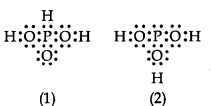
Describe the change in hybridisation (if any) of the Al atom in the following reaction. AlCl3 + Cl– ——>AlCl4- .
Predict the shapes of the following molecules on the basis of hybridization. BC13, ch4, co2, nh3
Assertion (A): Though the central atom of both NH3 and H20 molecules are sp3 hybridised, yet H – N – H bond angle is greater than that of H – O – H.
Reason (R): This is because nitrogen atom has one lone pair and oxygen atom has two lone pairs.
(a) A and R both are correct, and R is the correct explanation of A.
(b) A and R both are correct, but R is not the correct explanation of A.
(c) A is true but R is false.
(d) A and R both are false.
Write Lewis symbols for the following atoms and ions: S and S2– ; Al and Al3+; H and H–
Considering X-axis as the intemuclear axis which out of the following will not form a sigma bond and why? (a) Is and Is (b) Is and 2px (c) 2py and 2py (d) Is and 2s
Write the Lewis dot symbols of the following elements and predict their valencies. (i) Cl (ii) P
Polarity in a molecule and hence the dipole moment depends primarily on electronegativity of the constituent atoms and shape of a molecule. Which of the following has the highest dipole moment?
(a) C02
(b) HI
(c) H20
(d) S02
In N0–3 ion, the number of bond pairs and lone pairs of electrons on nitrogen atom are
(a) 2, 2 (b) 3, 1 (c) 1,3 (d) 4, 0
Explain the non linear shape of H2S and non planar shape of PCl3 using valence shell electron pair repulsion theory.
Structures of molecules of two compounds are given below:

(a) Which of the two compounds will have intermolccular hydrogen bonding and which compound is expected to show intramolecular hydrogen bonding?
(b) The melting point of a compound depends on. among other things, the extent of hydrogen bonding. On this basis explain which of the above two compounds will show higher melting point.
(c) Solubility of compounds in water depends on power to form hydrogen bonds with water. Which of the above compounds will form hydrogen bond with water easily and be more soluble in it?
Arrange the following bonds ‘in order of increasing ionic character giving reason.
N-H, F-H, C-H and O-H
What is meant by the term average bond enthalpy? Why there is difference in bond enthalpy of O – H bond in ethanol (C2H5OH) and water?
Match the species in Column I with the type of hybrid orbitals in Column II.
| Column I | Column II |
| (i) SF4 | (a) sp3cf |
| (ii) if5 | (b) d2sp3 |
| (iii) NO2+ | (c) sp3 d |
| (iv) NH4 | (d) sp3 |
| (e) sp |
Match the species in Column I with the geometry/shape in Column II.
| Column I | Column II |
| (i) H30+ | (a) Linear |
| (ii) HC = CH | (b) Angular |
| (iii) Cl0–2 | (c) Tetrahedral |
| (iv) NH+4 | (d) Trigonal bipyramidal |
| – | (e) Pyramidal |