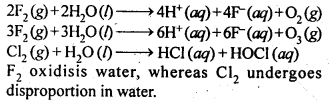
Question:
Write the reactions of F2 and Cl2 with water.
The p-Block Elements.
Q 1.
Complete the following reactions:
(i)C2H2 + O2 -> (ii) 4Al + 3 O2 ->
Q 2.
Assertion (A): HNO3 makes from passive.
Reason (R): HNO3 forms a protective layer of ferric nitrate on the surface of iron.
Q 3.
Why does NH3 form hydrogen bond but PH3 does not?
Q 4.
Explain why NH3 is basic while BiH3 is only feebly basic.
Q 5.
Justify the placement of O, S, Se, Te and Po in the same group’of the periodic table in terms of electronic configuration, oxidation state and hydride formation.
Q 6.
In the ring test of NO3 ion.Fe2+ion reduces nitrate ion to nitric oxide, which combines with Fe2+ (aq.) ion to form brown complex. Write the reactions involved in the formation of brown ring.
Q 7.
Assertion (A): HI cannot be prepared by the reaction of KI with concentrated H2SO4.
Reason (R): HI has lowest H – X bond strength among halogen acids.
Q 8.
Why are pentahalides more covalent than trihalidcs?
Q 9.
What is the basicity of H3PO4?
Q 10.
Why is ICI more reactive than l2?
Q 11.
How is nitrogen prepared in the laboratory? Write the chemical equations of the reactions . involved.
Q 12.
How is ammonia manufactured industrially?
Q 13.
Give the formula and describe the structure of a noble gas species which is isostructural with: (i) ICI4– (ii) IBr2– (iii) Br03–
Q 14.
Can PCl5 act as an oxidising as well as a reducing agent Justify.
Q 15.
With what neutral molecule is CIO– isoelectronic? Is that molecule a Lewis base?
Q 16.
Write the structure of pyrophosphoric acid.
Q 17.
SF6 is known but SCl6 is not. Why?
Q 18.
Nitric acid forms an oxide of nitrogen on reaction with P4O10. Write the reaction involved. Also write the resonating structures of the oxide of nitrogen formed.
Q 19.
PCl5 reacts with finely divided silver on heating and a white silver salt is obtained, which dissolves on adding excess aqueous NH3 solution. Write the reactions involved to explain what happens.
Q 20.
Why is N2 less reactive at room temperature?
Q 21.
How does ammonia react with a solution of Cu2+?
Q 22.
Why is bond angle in PH+4 ion higher than in PH3 ? (Pb. Board 2009)
Q 23.
What happens when white phosphorus is heated with concentrated NaOH solution in an inert atmosphere of CO2?
Q 24.
Write a balanced equation for the hydrolytic reaction of PC is in heavy water.
Q 25.
What happens when H3PO4 is heated?
Q 26.
Why is H2O a liquid and H2S a gas?
Q 27.
How is the presence of SO2 detected?
Q 28.
Write the conditions to maximise the yield of H2SO4 by Contact process.
Q 29.
Name two poisonous gases which can be prepared from chlorine gas
Q 30.
Why has it been difficult to study the chemistry of radon?
Q 31.
Illustrate how copper metal can give different products on reaction with HN03.
Q 32.
Give the resonating structures of N02 and N2O5.
Q 33.
Why does R3P=0 exist but R3N=0 does not (R is an alkyl group) ?
Q 34.
. Nitrogen exists as diatomic molecule and phosphorus as P4. Why?
Q 35.
Why does nitrogen show catenation properties less than phosphorus ? (C.B.S.E. Foreign 2009)
Q 36.
Which aerosols deplete ozone?
Q 37.
What inspired N. Bartlett for carrying out reaction between Xe and PtF6?
Q 38.
Write balanced equations for the following:
(i) NaCl is heated witlrsulphuric acid in the presence of MnO2
(ii) Chlorine gas is passed into a solution of Nal in water.
Q 39.
How are xenon fluorides XeF2, XeF4 and XeF6 obtained?
Q 40.
With which neutral molecule is ClO– isoelectronic? Is this molecule Lewis acid or base ? (Pb. Board 2009)
Q 41.
Why are pentahalides more covalent than trihalidcs ?
Q 42.
What happens when PCl5 is heated?
Q 43.
What is the basicity of H3PO4?
Q 44.
Write the order of thermal stability of the – hydrides of Group 16 elements.
Q 45.
Which of the following does not react with oxygen directly? Zn, Ti, Pt, Fe
Q 46.
Comment on the nature of two S-O bonds formed in S02 molecule. Are the two S-O bonds in this molecule equal ?
Q 47.
How is the presence of SO2 detected ?
Q 48.
Mention three areas in which H2SO4 plays an important role.
Q 49.
Why does NH3 form hydrogen bond but PH3 does not?
Q 50.
How is ammonia manufactured industrially?