
Chemistry

The p-Block Elements.

Question:

What happens when sulp’hur dioxide is passed through an aqueous solution of Fe(III) salt?

Answer:

SO2 acts as a reducing agent and reduces aqueous solution of Fe (III)salt to Fe (II) salt.
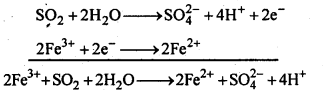
NCERT Solutions For Class 12 Chemistry Chapter 7 The p Block Elements Textbook Questions Q20

previuos
next

The p-Block Elements.

Q 1.

 Why is BiH3 the strongest reducing agent amongst all the hydrides of group 15 elements? (C.B.S.E. 2013)

Q 2.

Which of the following statements are correct?
(a) Among halogens, radius ratio between iodine and fluorine is maximum.
(b) Leaving F – F bond, all halogens have weaker X – X bond than X – X’ bond in interhalogens.
(c) Among interhalogen compounds maximum number of atoms ate present in iodine fluoride.
(d) Interhalogen compounds are more reactive than halogen compounds.

Q 3.

Justify the placement of O, S, Se, Te and Po in the same group’of the periodic table in terms of electronic configuration, oxidation state and hydride formation.

Q 4.

Why is dioxygen a gas but sulphur a solid?

Q 5.

Which of the following statements are correct for SO2  gas?
(a) It acts as a bleaching agent in moist conditions.
(b) Its molecule has a linear geometry.
(c) Its dilute solution is used as disinfectant.
(d) It can be prepared by the reaction of dilute H2SO4 with metal sulphide.

Q 6.

Name three oxoacids of nitrogen. Write the disproportionation reaction of that oxoacid of nitrogen in which nitrogen is in +3 oxidation state.

Q 7.

Explain why fluorine forms only one oxoacid, HOF.

Q 8.

Discuss the trends in chemical reactivity of group 15 elements.

Q 9.

Why is dioxygen a gas but sulphur a solid?

Q 10.

How is O3 estimated quantitatively?

Q 11.

Why does NH3 form hydrogen bond but PH3 does not?

Q 12.

 Write two uses of ClO2

Q 13.

Discuss the general characteristics of Group 15 elements with reference to their electronic configuration, oxidation state, atomic size, ionisation enthalpy and electronegativity.

Q 14.

Explain why does the stability of oxoacids of chlorine increase in the order given below:
HClO < HClO2 < HClO3 < HClO4

Q 15.

Assertion (A): HNO3 makes from passive.
Reason (R): HNO3 forms a protective layer of ferric nitrate on the surface of iron.

Q 16.

On heating compound (A) gives a gas (B) which is a constituent of air. This gas when treated with 3 mol of hydrogen (H2   ) in the presence of a catalyst gives another gas (C) which is basic in nature. Gas C on further oxidation in moist condition gives a compound (D) which is a part of acid rain. Identify compounds (A) to (D) and also give necessary equations of all the steps involved. –

Q 17.

Why is ICI more reactive than l2?

Q 18.

 How is SO2 an air pollutant?

Q 19.

Write a balanced equation for the hydrolytic reaction of PC is in heavy water.

Q 20.

How is nitrogen prepared in the laboratory? Write the chemical equations of the reactions . involved.

Q 21.

Why does nitrogen show catenation properties less than phosphorus?

Q 22.

Justify the placement of O, S, Se, Te and Po in the same group'of the periodic table in terms of electronic configuration, oxidation state and hydride formation.

Q 23.

White phosphorus reacts with chlorine and the product hydrolysis in the presence of water. Calculate the mass of HCl obtained by the hydrolysis of the product formed by the reaction of 62 g of white phosphorus with chlorine in the presence of water.

Q 24.

Phosphorus forms a number of oxoacids. Out of these oxoacids phosphinic acid has strong reducing property. Write its structure and also write a reaction showing its reducing behaviour.

Q 25.

Assertion (A): HI cannot be prepared by the reaction of KI with concentrated H2SO4.
Reason (R): HI has lowest H – X bond strength among halogen acids.

Q 26.

 What happens when white phosphorus is heated with concentrated NaOH solution in an inert atmosphere of CO2?

Q 27.

Write the reactions of F2 and Cl2 with water.

Q 28.

Bond angle in PH4+ is higher than that in PH3. Why?

Q 29.

Comment on the nature of two S-O bonds formed in S02 molecule. Are the two S-O bonds in this molecule equal ?

Q 30.

Why does NH3 form hydrogen bond but PH3 does not?

Q 31.

Write balanced equations for the following:
(i) NaCl is heated witlrsulphuric acid in the presence of MnO2
(ii) Chlorine gas is passed into a solution of Nal in water.

Q 32.

A brown ring is formed in the ring test for NO3 ion. It is due to the formation of
ncert-exemplar-problems-class-12-chemistry-p-block-elements-10

Q 33.

If chlorine gas is passed through hot NaOH solution, two changes are observed in the oxidation number of chlorine during the reaction. These are —— and ——-

Q 34.

Match the items of Column I and Column II and mark the correct option.
ncert-exemplar-problems-class-12-chemistry-p-block-elements-53

Q 35.

What is the basicity of H3PO4?

Q 36.

Why is H2O a liquid and H2S a gas?

Q 37.

Give the disproportionation reaction of H3 P03.

Q 38.

What inspired N. Bartlett for carrying out reaction between Xe and PtF6?

Q 39.

What happens when H3PO4 is heated?

Q 40.

How is ammonia manufactured industrially?

Q 41.

The HNH angle value is higher than HPH, H AsH and HSbH angles. Why?
(Hint: Can be explained on the basis of sp3 hybridisation in NH3 and only s-p bonding , between hydrogen and other elements of the group).

Q 42.

Reduction potentials of some ions are given below. Arrange them in decreasing order of oxidizing power.
ncert-exemplar-problems-class-12-chemistry-p-block-elements-18

Q 43.

On reaction with Cl2, phosphorus forms two types of halides ‘A' and ‘B'. Halide A is yellowish-white powder but halide B' is colourless oily liquid. Identify A and B and write the formulas of their hydrolysis products.

Q 44.

In the ring test of NO3 ion.Fe2+ion reduces nitrate ion to nitric oxide, which combines with Fe2+  (aq.) ion to form brown complex. Write the reactions involved in the formation of brown ring.

Q 45.

Match the items of Column I and Column II and mark the correct option.
ncert-exemplar-problems-class-12-chemistry-p-block-elements-49
ncert-exemplar-problems-class-12-chemistry-p-block-elements-50

Q 46.

What happens when sulp’hur dioxide is passed through an aqueous solution of Fe(III) salt?

Q 47.

 How is the presence of SO2 detected?

Q 48.

 Arrange the following in the order of property indicated for each set: –
(i) F2 , Cl2 , Br2 , I2 – increasing bond dissociation enthalpy.
(ii) HF, HCI, HBr, HI – increasing acid . strength.
(iii) NH3, PH3, AsH3, SbH3, BiH3 – increasing Sol. base strength.

Q 49.

Why is BiH3 the strongest reducing agent amongst all the hydrides of Group 15 elements?

Q 50.

What happens when PCl5 is heated?