

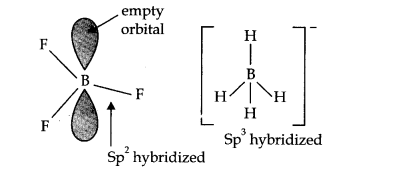
Describe the shapes of BF3 and BH4–. Assign the hybridisation of boron in these species.
In BF3, boron is SP2 hybridized.
∴ shape of BF3 = planar.
In [BH4]–, boron is sp3 hybridized, thus the shape is tetrahedral.


Boric acid is an acid because its molecule
(a) contains replaceable H+ ion
(b) gives up a proton.
(c)accepts OH–from water releasing proton.
(d) combines with proton from water molecule.
A certain salt X, gives the following results.
(i) Its aqueous solution is alkaline to litmus.
(ii) It swells up to a glassy material Y on strong heating.
(iii) When cone.H2SO4is added to a hot solution of X, white crystal of an acid Z separates out.
Boric acid is polymeric due to
(a) its acidic nature (b) the presence of hydrogen bonds
(c) its monobasic nature (d) its geometry
Describe the shapes of BF3 and BH4–. Assign the hybridisation of boron in these species.
Elements of group 14
(a) exhibit oxidation state of +4 only (b) exhibit oxidation state of +2 and +4
(c) form M2-and M4+ ion (d) form M2+ and M4+ ions.
Ionisation enthalpy (∆ tH1 kJ mol-1) for the elements of Group 13 follows the order.
(a) B > A1 > Ga > In > T1
(b) B < A1 < Ga< In
(d) B > A1 < Ga > In < T1
The reason for small radius of Ga compared to Al is_________ .
(a) poor screening effect of d and f orbitals
(b) increase in nuclear charge
(c) presence of higher orbitals
(d) higher atomic number
Which of the following statements are correct?
(a) Fullerenes have dangling bonds.
(b) Fullerenes are cage-like molecules.
(c) Graphite is thermodynamically most stable allotrope of carbon.
(d) Graphite is slippery and hard and therefore used as a dry lubricant in
Give the chemical reaction as an evidence for each of the following observations.
(i) Tin (II) is a reducing agent whereas lead (II) is not.
(ii) Gallium (I) undergoes disproportionation reaction.
Carbon and silicon both belong to the group 14, but in spite of the stoichiometric similarity, the dioxides (i.e., carbon dioxide and silicon dioxide) differ in their structures. Comment.
Give the chemical reactions as an evidence for each of the following observations.
(i) Tin (II) is a reducing agent whereas lead (II) is not.
(ii) Gallium (I) undergoes disproportionation reaction.
In some of the reactions thallium resembles aluminium, whereas in others it resembles with group 1 metals. Support this statement by giving some evidences.
Match the species given in Column I with the hybridisation given in Column II.
| Column I | Column II |
| (i) Boron in [B(OH)4]" | (a) sp2 |
| (ii) Aluminium in [A1(H20)6]3+ | (b) sp3 |
| (iii) Boron in B2H6 | (c) sp3d2 |
| (iv) Carbon in Buckminsterfullerene | |
| (v) Silicon in SiO44- | |
| (vi) Germanium in [GeCl6]2- |
Explain why is there a phenomenal decrease in ionization enthalpy from carbon to silicon.
Give reasons for the following:
(a) CCl4 is immiscible in water, whereas SiCl4 is easily hydrolysed.
(b) Carbon has a strong tendency for catenation compared to silicon.
Match the species given in Column I with the properties mentioned in Column II.
| Column I | Column II |
| (i) BF4– | (a) Oxidation state of central atom is +4 |
| (ii) A1C13 | (b) Strong oxidising agent |
| (iii) SnO | (c) Lewis acid |
| (iv) Pb02 | (d) Can be further oxidised |
| (e) Tetrahedral shape |
Match the species given in Column I with properties given in Column II.
| Column I | Column II |
| (i) Diborane | (a) Used as a flux for soldering metals |
| (ii) Gallium ‘ | (b) Crystalline form of silica |
| (iii) Borax | (c) Banana bonds |
| (iv) Aluminosilicate | (d) Low melting, high boiling, useful for measuring high temperatures |
| (v) Quartz | (e) Used as catalyst in petrochemical industries |
Assertion (A): If aluminium atoms replace a few silicon atoms in three dimensional network of silicon dioxide, the overall structure acquires a negative charge.
Reason (R): Aluminium is trivalent while silicon is tetravalent.
(a) Both A and R are true and R is the correct explanation of A.
(b) Both A and R are true but R is not the correct explanation of A.
(c) Both A and R are not correct.
(d) A is not correct but R is correct.
The+1 oxidation state in group 13 and +2 oxidation state in group 14 becomes more and more stable with increasing atomic number. Explain.
Assertion (A): Silicones are water repelling in nature.
Reason (R): Silicones are organosilicon polymers, which have (-R2SiO-) as repeating unit.
(a) Both A and R are true and R is the correct explanation of A.
(b) Both A and R are true but R is not the correct explanation of A.
(c) Both A and R are not correct. ‘
(d) A is not correct but R is correct.
What are electron deficient compounds? Are BCl3 and SiCl4 electron deficient species? Explain.
Explain the difference in properties of diamond and graphite on the basis of their structures.
Thermodynamically the most stable form of carbon is
(a)diamond (b) graphite (c) fullerenes (d) coal
What happens when
(i) Quick lime is heated with coke?
(ii) Carbon monoxide reacts with Cl2?
Give reason.
(i) C and Si are always tetravalent but Ge, Sn, Pb show divalency.
(ii) Gallium has higher ionization enthalpy than Al. Explain.
Give reasons:
(a) Why do Boron halides form addition compound with NH3?
(b) The tendency for catenation decreases down the group in Group 14.
(c) PbO2 is a stronger oxidising agent than SnO2.
The linear shape of C02 is due to ______ .
(a) sp3 hybridisation of carbon
(b) sp hybridisation of carbon
(c) pπ-pπ bonding between carbon and oxygen
(d) sp2 hybridisation of carbon
Explain the following:
(i) C02 is a gas whereas Si02 is a solid.
(b) Silicon forms SiF62- ion whereas corresponding fluoro compound of carbon is not known.
If a trivalent atom replaces a few silicon atoms in three dimensional network of silicon dioxide, what would be the type of charge on overall structure?