Ka for CH3COOH is 1.8 x 10⁻⁵ and Kb for NH4OH is 1.8 x 10⁻⁵. The pH of ammonium acetate will be
(a) 7.005
(b) 4.75
(c) 7.0
(d) Between 6 and 7
(c) Ammonium acetate is a salt of weak acid and weak base.


Arrange the following in increasing order of pH.
KN03(aq), CH3COONa(aq), NH4Cl(aq), C6H5COONH4(aq)
The value of Kc for the reaction 2A——>B + C is 2 x 10⁻³. At a given time, the composition of reaction mixture is [A] = [B] = [C] = 3 x 10⁻⁴ M. In which direction the reaction will proceed?
The value of Kc for the reaction 302(g) —>203(g) is 2.0 x 10-50 at 25 °C. If equilibrium concentration of 02 in air at 25 °C is 1.6 x 10⁻², what is the concentration of O3?
(i) Define Le Chatelier’s principle.
(ii) Following reactions occur in a Blast furnace.
Fe203(s) + 3CO(g) ———–>2Fe(s) + 3CO2(g)
use Le chatelier’s principle to predict the direction of reaction when equilibrium mixture is disturbed by
(a) adding Fe203 (b) removing CO2 .
(c) removing CO.
The pH of a sample of vinegar is 3.76. Calculate the concentration of hydrogen ion in it.
The degree of ionization of a 0.1 M bromoacetic acid solution is 0.132. Calculate the pH of the solution and the PKa of bromoacetic acid.
For the reaction N204(g) ⇌2N02(g), the value of K is 50 at 400 K and 1700 at 500 K. Which of the following options is correct?
(a) The reaction is endothermic.
(b) The reaction is exothermic.
(c) If NO2(g) and N204(g) are mixed 400 K at partial pressures 20 bar and 2 bar respectively, more N204(g) will be formed.
(d) The entropy of the system increases.
The pH of0.005 M codeine (C18H21N03) solution is 9.95. Calculate the ionization constant and PKb.
On the basis of the equation pH = -log [H+], the pH of 10-8 mol dm-3 solution of HC1 should be 8. However, it is observed to be less than 7.0. Explain the reason.
A sample of HI (g) is placed in a flask at a pressure of 0.2 atm. At equilibrium partial pressure of HI (g) is 0.04 atm. What is Kp for the given equilibrium?

What is meant by conjugate acid-base pair? Find the conjugate acid/base for the following species: HNO2, CH–, HClO4 , OH–, CO32-, S2-
The ionization constant of HF, HCOOH and HCN at 298 K are is 6.8 x 10⁻⁴ , 1.8 x 10⁻⁴ and 4.8 x 10⁻⁹ respectively, Calculate the ionization constant of the corresponding conjugate base.
A liquid is in equilibrium with its vapours in a sealed container at a fixed temperature. The volume of the container is suddenly increased, (i) What is the initial effect of the change on the vapour pressure? (ii) How do the rates of evaporation and condensation change initially? (iii) What happens when equilibrium is restored finally and what will be the final vapour pressure?
A sparingly soluble salt gets precipitated only when the product of concentration of its ions in the solution (Qsp) becomes greater than its solubility product. If the solubility of BaS04 in water is 8 x 10⁻⁴ mol dm-3, calculate its solubility in 0.01 mol dm-3 of H2S04.
Predict which of the following will have appreciable concentration of reactants and products:

BF3 does not have proton but still acts as an acid and reacts with NH3. Why is it so? What type of bond is formed between the two?
Hydrogen gas is obtained from the natural gas by partial oxidation with steam as per following endothermic reaction:

Write the expression for Kpfor the above reaction
How will the value of Kp and composition of equilibrium mixture be affected by:
(i) increasing the pressure, (ii) increasing the temperature, (iii) using a catalyst?
PCl5, PCl3 and Cl2 are at equilibrium at 500 K and having concentration 1.59M PCl5 1.59M Cl2 and 1.41M PCl5. Calculate Kc for the reaction PCl5———>PC13+ Cl2
A reaction between ammonia and boron trifluoride is given below:
:NH3 + BF3 →H3N : BF3
Identify the acid and base in this reaction. Which theory explains it? What is the hybridization of B and N in the reactants?
The equilibrium constant expression for a gas reaction is,
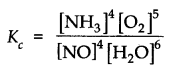
Write the balanced chemical equation corresponding to this expression.
pH of a solution of a strong acid is 5.0. What will be the pH of the solution obtained after diluting the given solution a 100 times?
Assuming complete dissociation, calculate the pH of the following solutions:
(a) 0.003 M HCl (b) 0.005 M NaOH (c) 0.002 M HBr (d) 0.002 M KOH
What is the effect of:
(i) addition of H2 (ii) addition of CH3OH
(iii) removal of CO (iv) removal of CH3OH

Nitric oxide reacts with bromine and gives nitrosyl bromide as per reaction given below:

When 0.087 mole of NO and 0.0437 mole of Br2 are mixed in a closed container at constant temperature, 0.0518 mole of NOBr is obtained at equilibrium. Determine the compositions of the equilibrium mixture.
The species H20, HCO3–, HSO4– and NH3 can act both as Bronsted acid and base. For each case, give the corresponding conjugate acid and base.
Does the number of moles of reaction products increase, decrease or remain same when each of the following equilibria is subjected to a decrease in pressure bp increasing the volume?
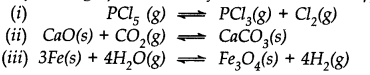
In the reaction A + B———> C + D, what will happen to the equilibrium if concentration of A is increased?
(b) The equilibrium constant for a reaction is 2 x 10-23 at 25 °C and 2 x 10⁻² at 50 °C. Is the reaction endothermic or exothermic?
(c) Mention at least three ways by which the concentration of S03 can be increased in the following reaction in a state of equilibrium.
The aqueous solution of sugar does not conduct electricity. However, when sodium chloride is added to water, it conducts electricity. How will you explain this statement on the basis of ionization and how is it affected by concentration of sodium chloride?
Calculate the volume of water required to dissolve 0.1 g lead (II) chloride to get a saturated solution. (Ksp of PbCl2 = 3.2 x 10⁻⁸, atomic mass of Pb = 207 u).
Dihydrogen gas is obtained from natural gas by partial oxidation with steam as per following endothermic reaction:
CH4(g) + H2O(g) ——> CO(g) + 3 H2(g)
(a) Write an expression for Kpfor the above reaction.
(b) How will the values of Kp and composition of equilibrium mixture be affected by (i) increasing the pressure (ii) increasing the temperature (iii) using a catalyst?
The ionization constant of an acid, Ka is the measure of strength of an acid. The Ka values of acetic acid, hypochlorous acid and formic acid are 1.74 x 10⁻⁵, 3.0 x 10⁻⁸ and 1.8 x 10⁻⁴ Which of the following orders of pH of 0.1 mol dm-3 solutions of these acids is correct?
(a) acetic acid > hypochlorous acid > formic acid
(b) hypochlorous acid > acetic acid > formic acid
(c) formic acid > hypochlorous acid > acetic acid
(d) formic acid > acetic acid > hypochlorous acid
For the following equilibrium, K =6.3 x 10¹⁴ at 1000 K. NO(g)+O3 —–>NO2(g) + O2(g) Both the forward and reverse reactions in the equilibrium are elementary bimolecular reactions. What is Kc for the reverse reaction ?
A mixture of 1.57 mol of N2, 1.92 mol of H2 and 8.13 mol of NH3is introduced into a 20 L reaction vessel at 500 K. At this temperature, the equilibrium constant Kc for the reaction

Is this reaction at equilibrium? If not, what is the direction of net reaction?
Calculate (a) ∆G– and (b) the equilibrium constant for the formation of N02 from NO and 02 at 298 K

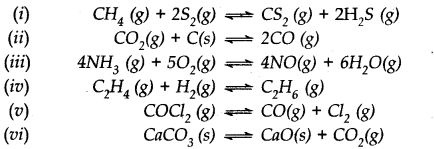
Which of the following reactions will get affected by increase in pressure ? Also mention whether the change will cause the reaction to go to the right or left direction.