

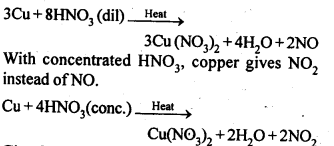
Illustrate how copper metal can give different products on reaction with HN03.
On heating with dil HN03, copper gives copper nitrate and nitric oxide.


Name three oxoacids of nitrogen. Write the disproportionation reaction of that oxoacid of nitrogen in which nitrogen is in +3 oxidation state.
Explain why inspite of nearly the same electronegativity, nitrogen forms hydrogen bonding while chlorine does not.
Explain why does the stability of oxoacids of chlorine increase in the order given below:
HClO < HClO2 < HClO3 < HClO4
In the preparation of H2S06 by contact process, why is S03 not absorbed directly in water to form H2S04?
PCl5 reacts with finely divided silver on heating and a white silver salt is obtained, which dissolves on adding excess aqueous NH3 solution. Write the reactions involved to explain what happens.
Phosphorus forms a number of oxoacids. Out of these oxoacids phosphinic acid has strong reducing property. Write its structure and also write a reaction showing its reducing behaviour.
Assertion (A): HNO3 makes from passive.
Reason (R): HNO3 forms a protective layer of ferric nitrate on the surface of iron.
On heating ammonium dichromate and barium azide separately we get
(a) N2 in both cases
(b) N2 with ammonium dichromate and NO with barium azide
(c) N2O with ammonium dichromate and N2 with barium azide
(d) N2O with ammonium dichromate and N2O with barium azide
Which of the following is correct for P4 molecule of white phosphorus?
(a) It has 6 lone pairs of electrons (b) It has six P – P single bonds
(c) It has three P – P single bonds (d) It has four lone pairs of electrons,
Which of the following statements are correct?
(a) Among halogens, radius ratio between iodine and fluorine is maximum.
(b) Leaving F – F bond, all halogens have weaker X – X bond than X – X’ bond in interhalogens.
(c) Among interhalogen compounds maximum number of atoms ate present in iodine fluoride.
(d) Interhalogen compounds are more reactive than halogen compounds.
Which of the following statements are correct?
(a) S – S bond is present in H2S2O6.
(b) In peroxosulphuric acid (H2SO5) sulphur is in +6 oxidation state.
(c) Iron powder along with Al2O3 and K2O is used as a catalyst in the preparation of NH3 by Haber's process
(d) Change in enthalpy is positive for the preparation of SO3 by catalytic oxidation of SO2.
Write a balanced chemical equation, for the reaction showing catalytic oxidation of NH3 by atmospheric oxygen.
Why is BiH3 the strongest reducing agent amongst all the hydrides of group 15 elements? (C.B.S.E. 2013)
How is nitrogen prepared in the laboratory? Write the chemical equations of the reactions . involved.
Why does nitrogen show catenation properties less than phosphorus ? (C.B.S.E. Foreign 2009)
Justify the placement of O, S, Se, Te and Po in the same group’of the periodic table in terms of electronic configuration, oxidation state and hydride formation.
Why is BiH3 the strongest reducing agent amongst all the hydrides of Group 15 elements?

