

Give an expression for the van der Wools equation. Give the significance of the constants used in the equation. What are their units?
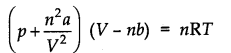
When n is the no. of moles present and ‘a' and ‘V are known as van der Waals constants.
Significance of van der Waals constants
van der Waals constant ‘a' : ‘a' is related to the magnitude of the attractive forces among the molecules of a particular gas. Greater the value of V, more will be the attractive forces.
Unit of ‘a’ = L2 mol-2
van der Waals Constant ‘b’: ‘b’ determines the volume occupied by the gas molecules which depends upon size of molecule.
Unit of ‘b’ = L mol-1.


Match the graph between the following variables with their names.
| Column I (Graphs) | Column II (Names) |
| (i) Pressure vs temperature graph at constant molar volume. | (a) Isotherms |
| (ii) Pressure vs volume graph at constant temperature. | (b) Constant temperature curve |
| (iii) Volume vs temperature graph at constant pressure. | (c) Isochores |
| (d) Isobars |
The critical temperature (Tc) and critical pressure (Pc) of C02 are 30.98 °C and 73 atm respectively. Can C02(g) be liquefied at 32 °C and 80 atm pressure?
Assertion (A): At constant temperature, PV vs V plot for real gases is not a straight line.
Reason (R): At high pressure all gases have Z> 1 but at intermediate pressure most gases have Z < 1.
(a) Both A and R are true and R is the correct explanation of A.
(b) Both A and R are true but R is not the correct explanation of A.
(c) A is true but R is false.
(d) A is false but R is true.
Assertion (A): Gases do not liquefy above their critical temperature, even on applying high pressure.
Reason (R): Above critical temperature, the molecular speed is high and intermolecular attractions cannot hold the molecules together because they escape because of high speed.
(a) Both A and R are true and R is the correct explanation of A.
(b) Both A and R are true but R is not the correct explanation of A.
(c) A is true but R is false.
(d) A is false but R is true.
(a) Why aerated water bottles kept under water during summer?
(b) Which property of liquid is responsible for spherical shape of drop?
(c) Why is moist air lighter than dry air?
(d) Define aqueous tension.
(e) What are units of a and b which are van der Waals constants?
With regard to the gaseous state of matter which of the following statements are correct?
(a) Complete order of molecules (b) Complete disorder of molecules
(c) Random motion of molecules (d) Fixed position of molecules
A vessel of 120 mL capacity contains a certain amount of gas at 35 °C and 1.2 bar pressure. The gas is transferred to another vessel of volume 180 mL at 35 °C. What would be its pressure?
One of the assumptions of kinetic theory of gases is that there is no force of attraction between the molecules of a gas.
State and explain the evidence that shows that the assumption is not applicable for real gases.
Explain the effect of increasing the temperature of a liquid on intermolecular forces operating between its particles. What will happen to the viscosity of a liquid if its temperature is increased?
Assertion (A): Three states of matter are the result of balance between intermolecular forces and thermal energy of the molecules. .
Reason (R): Intermolecular forces tend to keep the molecules together but thermal energy of molecules tends to keep them apart.
(a) Both A and R are true and R is the correct explanation of A.
(b) Both A and R are true but R is not the correct explanation of A.
(c) A is true but R is false.
(d) A is false but R is true.
Which of the following changes decrease the vapour pressure of water kept in a sealed vessel?
(a) Decreasing the quantity of water
(b) Adding salt to water
(c) Decreasing the volume of the vessel to one-half
(d) Decreasing the temperature of water
Viscosity of a liquid arises due to strong intermolecular forces existing between the molecules. Stronger the intermolecular forces, greater is the viscosity. Name the intermolecular forces existing in the following liquids and arrange them in the increasing order of their viscosities. Also give reason for the assigned order in one line.Water, Hexane (CH3CH2CH2CH2CH2CH3), Glycerine (CH2OHCH(OH)CH2OH)
Assertion (A): At critical temperature liquid passes into gaseous state imperceptibly and continuously.
Reason (R): The density of liqtiid and gaseous phase is equal to critical temperature.
(a) Both A and R are true and R is the correct explanation of A.
(b) Both A and R are true but R is not the correct explanation of A.
(c) A is true but R is false.
(d) A is false but R is true.
What will be the pressure of the gas mixture when 0.5 L of H2 at 0.8 bar and 2.0 L of dioxygen at 0.7 bar are introduced in all vessel at 27 °C?
Calculate the temperature of 4.0 moles of a gas occupying 5 dm3 at 3.32 bar (R = 0.083 bar dm3 K-1 mol-1)
Value of universal gas constant (R) is same for all gases. What is its physical significance?
One of the assumptions of kinetic theory of gases states that "there is no force of attraction between the molecules of a gas."How far is this statement correct? Is it possible to liquefy an ideal gas? Explain.
Why does sharp glass edge become smooth on heating it up to its melting point in a flame? Explain which property of liquids is responsible for this phenomenon.
What will be the minimum pressure required to compress 500 dm3 of air at 1 bar to 200 dm3 at 30 °C?
Pressure of l g of an ideal gas A at 27 °C is found to be 2 bar. When 2 g of another ideal gas B is introduced in the same flask at same temperature, the pressure becomes 3 bar. Find the relationship between their molecular masses.
2.9 g of a gas at 95 °C occupied the same volume as 0.184 g of hydrogen at 17 °C at the same pressure. What is the molar mass of the gas ?
Critical temperature for Co2 and CH4 are 31.1 °C and -81.9 °C respectively. Which of these has stronger intermolecular forces and why ?
At 25 °C and 760 mm ofHg pressure a gas occupies 600 mL volume. What will be its pressure at a height where temperature is 10 °C and volume of the gas is 640 mL?
The magnitude of surface tension of liquid depends on the attractive forces between the molecules. Arrange the following in increasing order of surface tension:
water, alcohol (C2H5OH) and hexane [CH3(CH2)4CH3)].
Isotherms of carbon dioxide at various temperatures are represented in the following figure. Answer the following questions based on this figure.

(i) In which state will C02 exist between the points a and b at temperature T1
(ii) At what point will Co2 start liquefying when temperature is T1?
(iii) At what point will C02 be completely liquefied when temperature is T2?
(iv) Will condensation take place when the temperature is T3
(v) What portion of the isotherm at T1 represent liquid and gaseous C02 at equilibrium?
Using the equation of state PV = nRT, show that at a given temperature, density of a gas is proportional to the gas pressure P.
A weather balloon has a volume of 175 dm3 when filled with hydrogen gas at a pressure of 1.0 bar. Calculate the volume of the balloon when it rises to a height where the atmospheric pressure is 0.8 bar. Assume that temperature is constant.
(a) What do you mean by’Surface Tension'of a liquid?
(b) Explain the factors which can affect the surface tension of a liquid.
State and explain Dalton’s law of partial pressures. Can we apply Dalton's law of partial pressures to a mixture of carbon monoxide and oxygen?
Under which of the following two conditions applied together, a gas deviates most from the ideal behaviour?
(a) Low pressure (b) High pressure
(c) Low temperature (d) High temperature
Name the energy which arises due to motion of atoms or molecules in a body. How is this energy affected when the temperature is increased?
For real gases the relation between P, V and T is given by van der Waals equation:

where ‘a' and ‘b' are van der Waals constants, ‘nb' is approximately equal to the total volume of the molecules of a gas.
‘a' is the measure of magnitude of intermolecular attraction.
(i) Arrange the following gases in the increasing order of ‘b'. Give reason. 02, C02, H2, He
(ii) Arrange the following gases in the decreasing order of magnitude of ‘a'. Give reason.CH4, O2, H2
Assertion (A): Liquids tend to have maximum number of molecules at their surface.
Reason (R): Small liquid drops have spherical shape.
(a) Both A and R are true and R is the correct explanation of A.
(b) Both A and R are true but R is not the correct explanation of A.
(c) A is true but R is false.
(d) A is false but R is true.
