Question:
What are Plimsoll Lines?
Answer:
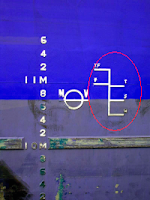
While loading a ship, care is taken it should not be loaded too much. Its load depends on the density of the sea in which it floats. The ship would sink if its load exceeds. To indicate the depth up to which the ship can sink in a sea of different densities under different climatic conditions, several lines are marked on the sides of the ship. It ensures stability and safety of the ship and these lines are called Plimsoll lines (name after sailor Captain Plimsoll) .
Gravitation
Q 1.
State Kepler’s Laws of planetary motion. How did Newton guess inverse square law ?
Q 2.
A particle is dropped from a tower 180 m high.How long does it take to reach the ground ? What is the velocity when it touches the ground ? Take g =
Q 3.
Calculate the value of acceleration due to gravity on Moon. Given mass of Moon =
kg, radius of Moon = 1740 km
Q 4.
Why do sewing needles and all pins have a sharp pointed tip?
Q 5.
What is the value of ‘g’ at the centre of Earth ?
Q 6.
A boy on a clif£ 49 m high drops a stone.One second later,he throws a second stone after the first.They both hit the ground at the same time. With what speed did he throw the second stone ?
Q 7.
Two stones A and B are dropped from a multistoried building. A is dropped from 100 m and after some time B is dropped from 50 m height. Both of them reach the earth at the same time. Will they have equal velocity while reaching the ground ? Calculate and find out the answer (take g =10 m/s
2).
Q 8.
Which force is responsible for tides in the ocean at night ?
Q 9.
Fill in the blanks :
Every object in the universe ________ other bodies.
Q 10.
Can you calculate density of Earth from Newton’s law of gravitation ?
Q 11.
Suppose a planet exists whose mass and radius both,are half those of Earth.Calculate the acceleration due to gravity on the surface of this planet.
Q 12.
What do we call the gravitational force between the Earth and an object ?
Q 13.
What do you mean by acceleration due to gravity ?
Q 14.
The mass of Earth is
kg and that of moon is
kg. If the distance between the Earth and the Moon is
km, calculate the force exerted by Earth on the Moon. Given G =
.
Q 15.
At what height above the surface of the earth, the value of 'g' becomes 64% of its value at the surface of the earth. Take radius of the earth = 6400 km.
Q 16.
Fill in the blanks :
________ of an object is the force of gravity acting on it.
Q 17.
What is the importance of universal law of gravitation ?
Q 18.
What is value of ‘g’ on Earth ?
Q 19.
State and explain universal law of gravitation given by Newton.What is the importance of this law
Q 20.
Who measured the value of G first time, experimentally?
Q 21.
Mass of an object is 10 kg. What is its weight on the Earth? (g = 9.8 m/s
2.)
Q 22.
Calculate the force of gravitation between two objects of masses 80 kg and 1200 kg kept at a distance of 10 m from eachother.Given, G =
/
.
Q 24.
A stone drops from the edge of the roof.It passes a window 2 m high in 0.1 s.How far is the roof above the top of the window
Q 25.
An object is thrown vertically upwards and rises to a height of 10 m. Calculate (i) the velocity with which the object was thrown upwards and (ii) the time taken by the object to reach the highest point.
Q 26.
A body is projected upwards. What is its velocity at maximum height
Q 27.
Distinguish between mass and weight.
Q 28.
What happens to 'g' experienced by a body when it moves up the earth's surface?
Q 29.
Fill in the blanks :
Universal gravitational constant G = _____________.
Q 30.
The weight of a man is 690N which contains 5.3 x 10
-3 m
3 of blood. Find (a) blood's weight. Take density of blood is 1060 kg/m
3 (b) express it as a percentage of body weight.
Q 31.
Why will a sheet of paper fall slower than one that is crumpled into a ball?
Q 32.
Why does a block of plastic released under water come up to the surface of the water?
Q 33.
Can a body have mass but no weight ?
Q 34.
Fill in the blanks :
When objects of different masses and sizes are dropped from same height would reach the ground at ______ (same time/different times), considering negligible air resistance.
Q 35.
Fill in the blanks :
The value of
g ________ (increases/decreases) as we go downwards from the earth's surface.
Q 36.
Why is G called the Universal Constant?
Q 37.
Does the force of attraction between two objects depend on the properties of intervening medium?
Q 39.
Fill in the blanks :
Assuming negligible air drag, if a steel ball and a table tennis ball are dropped from a height of 100 metres, both will reach the ground at ________ time(s). (same/different)
Q 40.
Write the formula to find the magnitude of the gravitational force between the Earth and an object on the surface of the Earth.
Q 41.
Why is the weight of an object on the Moon (l/6)th its weight on the Earth ?
Q 42.
A stone is thrown vertically upward with an initial velocity of 40 m/s.Taking g =
,find the maximum height reached by the stone.What is the net displacement and the total distance covered by the stone ?
Q 43.
A stone is allowed to fall from the top of a tower 100 m high and at the same time another stone is projected vertically upwards from the ground with a velocity of 25 m/s. Calculate when and where the two stones will meet

Q 44.
Write down the equations of motion of objects under the influence of gravitational force of Earth.Explain the meaning of the symbols used.
Q 45.
Fill in the blanks :
Kepler's Law of ______ states that a line that connects a planet to the Sun sweeps out equal ______ in the plane of the planet's orbit in _____time intervals.
Q 46.
Fill in the blanks :
The value of G was found out by _______ by using a ________.
Q 47.
Define 'g' or acceleration due to gravity? Does it depend on the mass of the body (near the surface of the earth)experiencing 'g'?
Q 48.
Write the standard equations in the form when an object is dropped from a height?
Q 49.
Is acceleration due to gravity a vector or a scalar? Write its S.I. unit.
Q 50.
A stone is released from the top of a tower of height 19.6 m. Calculate its final velocity just before touching the ground.



