

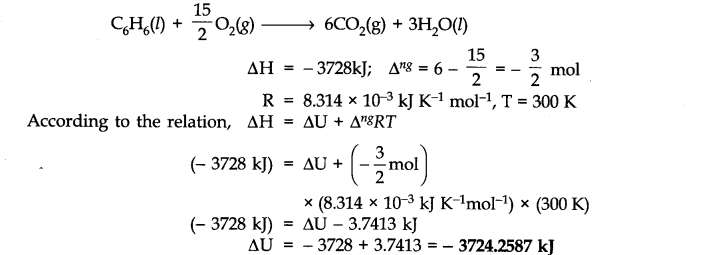
When liquid benzene is oxidised at constant pressure at 300 K, the change in enthalpy is -3728 kJ. What is the change in internal energy at the same temperature?
The chemical equation representing the oxidation of liquid benzene is :


Consider the following reaction between zinc and oxygen and choose the correct options out of the options given below:
2Zn(s) + 02(g) → 2ZnO(s); ∆H=-693.8 kJ mol-1
(i) The enthalpy of two moles ZnO is less than the total enthalpy of two moles of Zn and one mole of oxygen by 693.8 kJ.
(ii) The enthalpy of two moles of ZnO is more than the total enthalpy of two moles of Zn and one mole of oxygen by 693.8 kJ.
(iii) 8 kJ mol -1 energy is evolved in the reaction.
(iv) 693.8 kJ mol-1 energy is absorbed in the reaction.
Give reason for the following:
(a)Neither q nor w is a state function but q + w is a state function.
(b)A real crystal has more entropy than an ideal crystal.
The entropy change can be calculated by using the expression ∆S = q rev / T. When water freezes in a glass beaker, choose the correct statement amongst the following:
When water freezes in a glass beaker, choose the correct statement amongst the following:
(a) ∆S(system) decreases but ∆S(surroundings) remains the same.
(b) ∆S(system) increases but ∆S(surroundings) decreases.
(C) ∆S(system) decreases but ∆S(surroundmgs) increases.
(d) ∆S(system) decreases but ∆S(surroundings) also decreases.
The spontaneity means, having the potential to proceed without the assistance of external agency. The processes which occur spontaneously are
(a) flow of heat from colder to warmer body.
(b) gas in a container contracting into one comer.
(c) gas expanding to fill the available volume.
(d) burning carbon in oxygen to give carbon dioxide.
In an exothermic reaction, heat is evolved, and system loses heat to the surroundings. For such system
(a) qP will be negative
(b) ∆γHwill be negative
(c) qp will be positive
(d) ∆γHwill be positive.
Heat capacity (CP) is an extensive property but specific heat (c) is an intensive property. What will be the relation between Cp and c for 1 mol of water?
When two moles of C2H6(g) are burnt, 3129 kj of heat is liberated. Calculate the heat of formation of C2H6(g). ∆fH for C02(g) and H20(l) are-393.5 and -286 kj mol-1 respectively.
Define the following:
(i) First law of thermodynamics.
(ii) Standard enthalpy of formation.
The enthalpy of atomisation for the reaction CH4(g) → C(g) + 4H(g) is 1665 kJ mol-1. What is the bond energy of C – H bond?
What is the enthalpy of formation of the most stable form of an element in its standard state?
For an ideal gas. the work of reversible expansion under isothermal condition 1.0 mol of an ideal gas is expanded isothermally and reversibly to ten times of its original volume, in two separate experiments. The expansion is carried out at 300 K and at 600 K respectively. Choose the correct option.
can be calculated by using expression w = -nRT In Vf / Vi A sample containing
(a) Work done at 600 K is 20 times the work done at 300 K.
(b) Work done at 300 K is twice the work done at 600 K
(c) Work done at 600 K is twice the work done at 300 K.
(d) ∆U= 0 in both cases.
1 g of graphite is burnt in a bomb calorimeter in excess of oxygen at 298 K and 1 atmospheric pressure according to the equation C(graphite) + 02 (g) —> C02 (g) During the reaction, temperature rises from 298 K to 299 K. If the heat capacity of the bomb calorimeter is 20.7 kJ/K, what is the enthalpy change for the above reaction at 298 K and 1 atm?
Enthalpy is an extensive property. In general, if enthalpy of an overall reaction A→B along one route is ∆rH and ∆rH1, ∆rH2, ∆rH3 …. represent enthalpies of intermediate reactions leading to product B. What will be the relation between ∆rH for overall reaction and ∆rH1, ∆rH2….. etc. for intermediate reactions.
(a)What is a spontaneous process? Mention the conditions for a reaction to be spontaneous at constant temperature and pressure.
(b) Discuss the effect of temperature on the spontaneity of an exothermic reaction.
Calculate the number of kj of heat necessary to raise the temperature of 60 g of aluminium from 35 °C to 55 °C. Molar heat capacity of Al is 24 J mol-1 K-1.
One mole of acetone requires less heat to vapourise than 1 mol of water. Which of the two liquids has higher enthalpy of vapourisation?
Increase in enthalpy of the surroundings is equal to decrease in enthalpy of the system. Will the temperature of system and surroundings be the same when they are in thermal equilibrium?
A sample of 1.0 mol of a monoatomic ideal gas is taken through a cyclic process of expansion and compression as shown in the figure. What will be the value of ΔHfor the cycle as a whole?

Expansion of a gas in vacuum is called free expansion. Calculate the work done and the change in internal energy when 1 litre of ideal gas expands isothermally into vacuum until its total volume is 5 litre.
The bond enthalpy of H2(g) is 436 kj mol-1and that of N2 (g) is 941.3 kj mol-1. Calculate the average bond enthalpy of an N-H bond in ammonia. Given: ∆H– (NH3) = -46 kj mol-1
In an adiabatic process, no transfer-of heat takes place between system and surroundings. Choose the correct option for free expansion of an ideal gas under adiabatic condition from the following.

Thermodynamics mainly deals with
(a) interrelation of various forms of energy and their transformation front one from to another.
(b) energy changes in the processes which depend only on initial and final states of the microscopic system containing a few molecules.
(c) how and at what rate these energy transformations are carried out.
(d) the system in equilibrium state or moving from one equilibrium state to another equilibrium state.
Identify the state functions and path functions out of the following: enthalpy, entropy, heat, temperature, work, free energy.
The net enthalpy change of a reaction is the amount of energy required to break all the bonds in reactant molecules minus amount of energy required to form all the bonds in the product molecules. What will be the enthalpy change for the following reaction?
H2(g) + Br2(g)→2HBr(g)
Given that bond energy of H2, Br2 and HBr is 4.35 kJ mol-1,192 kJ mol-1 and 368 kJ mol -1 respectively.
In a process, 701 ] of heat is absorbed by a system and 394 J of work is done by the system. What is the change in internal energy for the process?
Given : N2(g) + 3H2(g) ————> 2NH3(g); ∆r H– = -92.4 kj mot-1 What is the standard enthalpy of formation of NH3 gas?
The enthalpies of elements in their standard states are taken as zero. The enthalpy of formation of a compound
(a) is always negative
(b) is always positive
(c) may be positive or negative
(d) is never negative






