

Write formulas for the following compounds:
(a) Mercury (II) chloride, (b) Nickel (II) sulphate, (c) Tin (IV) oxide, (d) Thallium
(I) sulphate, (e) Iron (III) sulphate, (f) Chromium (III) oxide.
(a) Hg(II)Cl2, (b) Ni(II)SO4, (c)Sn(IV)O2 (d) T12(I)SO4, (e) Fe2(III)(S04)3, (f) Cr2(III)O3.


Identify the correct statements with reference to the given reaction.
P4 + 30H– + 3H20→ PH3 + 3H2 P0–2
(a) Phosphorus is undergoing reduction only.
(b) Phosphorus is undergoing oxidation only.
(c) Phosphorus is undergoing oxidation as well as reduction.
(d) Hydrogen is undergoing neither oxidation nor reduction
Arrange the following metals in the order in which they displace each other from the solution of their salts.Al, Cu, Fe, Mg and Zn.
While sulphur dioxide and hydrogen peroxide can act as an oxidising as well as reducing agents in their reactions, ozone and nitric acid act only as oxidants. Why?
Calculate the oxidation number of phosphorus in the following species.
(a) HPO32- and (b) P043-
In Ostwald’s process for the manufacture of nitric add, the first step involves the oxidation of ammonia gas by oxygen gas to give nitric oxide gas and steam. What is the maximum wight of nitric oxide that can be obtained starting only with 10.0 g of ammonia and 20.0 g of oxygen?
Which of the following statement(s) is/are not true about the following decomposition reaction?
2KCIO3 →2KC1 + 302
(a) Potassium is undergoing oxidation.
(b) Chlorine is undergoing oxidation.
(c) Oxygen is reduced.
(d) None of the species are undergoing oxidation or reduction.
Which of the following electrodes will act as anodes, when connected to Standard Hydrogen Electrode?
(a) A13-/A1; E °= -1.66 V
(b) Fe2+ /Fe; E °= -0.44 V
(c) Cu2+/ Cu E °=34 V
(d) F2(g)/2F–(aq) E °= 2.87 V
Predict the products of electrolysis in each of the folloxving:
(i) An aqueous solution of AgNO3 with silver electrodes.
(ii) An aqueous solution of silver nitrate with platinum electrodes.
(iii) A dilute solution of H2S04with platinum electrodes.
(iv) An aqueous solution of CuCl2 with platinum electrodes.
What is standard hydrogen electrode? For what purpose it is used? What are signs of oxidation potential and reduction potential decided by using SHE (Standard hydrogen electrode)?
(a) Balance the following equation by oxidation number method or by ion electron (half reaction) method.

Nitric acid is an oxidizing agent and reacts with PbO but it does not react with Pb02. Explain why?
In which of the following compounds, an element exhibits two different oxidation states.
(a) NH2OH
(b) NH4NO3
(c) N2H4
(d) N3H
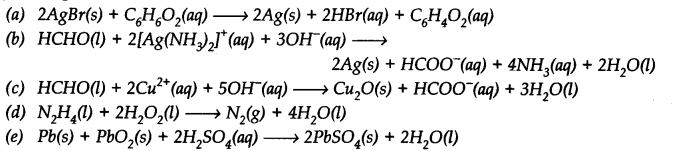
Identify the substance oxidised, reduced, oxidising agent and reducing agent for each of the following reactions.
Thiosulphate reacts differently with iodine and bromine in the reactions given below:
2S2032_ + I2→S4062- + 2I–
S2032- + 2Br2 + 5H20 →2S042- + 4Br– + 10H+
Which of the following statements justifies the above dual behaviour of thiosulphate?
(a) Bromine is a stronger oxidant than iodine.
(b) Bromine is a weaker oxidant than iodine.
(c) Thiosulphate undergoes oxidation by bromine and reduction by iodine in these reactions.
(d) Bromine undergoes oxidation and iodine undergoes reduction in these reactions.
Identify the correct statement(s) in relation to the following reaction:
Zn + 2HCl → ZnCl2 + H2
(a) Zinc is acting as an oxidant.
(b) Chlorine is acting as a reductant.
(c) Hydrogen ion is acting as an oxidant.
(d) Zinc is acting as a reductant.

Identify the redox reactions out of the following reactions and identify the oxidizing and reducing agents in them

Consider the elements: Cs, Ne, I, F
(a) Identify the element that exhibits -ve oxidation state.
(b) Identify the element that exhibits +ve oxidation state.
(c) Identify the element that exhibits both +ve and -ve oxidation states.
(d) Identify the element which neither exhibits -ve nor +ve oxidation state.
What is meant by electrochemical series? What are characteristics of electrochemical series?
Identify the substance oxidised, reduced, oxidising agent and reducing agent for each of the following reactions.

Justify that the following reactions are redox reactions:
(a) CuO(s) + H2(g) —–> Cu(s) + H20(g)
(b) Fe2O3(s) +3CO(g) —-> 2Fe(s) + 3CO2(g)
(c) 4BCl3(g) +3LiAlH4(s) ——> 2B2H6(g) + 3LiCl(s) + 3AlCl3(s)
(d) 2K(s) +F2(g)——> 2K+F–(s)
Consider the reactions:
(a) 6CO2(g) 6H2O(l) ———> C6H12O6(s) + 6O6(g) (b) O3(g) + H2O2(l) H2O(l) + 2O2(g)
Why it is more appropriate to write these reactions as:
(a) 6CO2(g) + 12H2O(l) ————-> C6H12O6(s) + 6H2O(l) + 6O2(g)
(b) O3(g) + H2O2 (l) ———–> H2O(l) + O2(g) + O2(g)
Also suggest a technique to investigate the path of above (a) and (b) redox reactions.
Balance the following redox reactions by ion-electron method.
(a) MnO4–(aq) +I–(aq) ———>Mn02(s) + I2 (s) (in basic medium)
(b) MnO4–(aq) + S02(g) ——-> Mn2+(aq) +H2S04–(in acidic solution)
(c) H2O2(aq) + Fe2+(aq) ———-> Fe3+(aq) + H2O(l) (in acidic solution)
(d) Cr2O72- (aq) + S02 (g)——> Cr3+ (aq) + SO42-(aq) (in acidic solution)
The exhibition of various oxidation states by an element is also related to the outer orbital electronic configuration of its atom. Atom(s) having which of the following outermost electronic configurations will exhibit more than one oxidation state in its/their compounds.
(a) 3s1
(b) 3dl4s2
(c) 3d24s2
(d) 3s23p3
Which of the following elements does not show disproportionation tendency?
(a) Cl
(b) Br
(c) F
(d) I
PbO and Pb02 react with HC1 according to following chemical equations:
2PbO + 4HCl → 2PbCl2 + 2H20
Pb02 + 4HC1 → PbCl2 + Cl2 + 2H20
Why do these compounds differ in their reactivity?
The compound AgF2 is unstable. However, if formed, the compound acts as a very strong oxidising agent. Why?
Consider a voltaic cell constructed with the following substances:
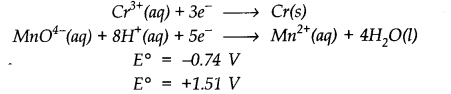
(a) Which substances are oxidised and reduced in this cell?
(b) Which are the negative and positive electrode?
The reaction Cl2(g) + 20H–(aq)→ Cl0–(aq) + Cl–(aq) + H20(l) represents the process of bleaching. Identify and name the species that bleaches the substances due to its oxidizing action.
Identify the oxidant and the reductant in the following reaction.
N2H4(g) + ClO4(aq) ———–> NO(g) + Cr(aq)
The largest oxidation number exhibited by an element depends on its outer electronic configuration. With which of the following outer electronic configurations the element will exhibit largest oxidation number?
(a) 3d14s2
(b) 3d2 4s2
(c) 3d54s1
(d) 3d54s2
Calculate the oxidation number of each sulphur atom in the following compounds:
(a) Na2S203
(b) Na2S406
(c) Na2S03
(d) Na2S04
Depict the galvanic cell in which the reaction, Zn(s) + 2Ag+(aq) ————> Zn2+(aq) + 2Ag(s)
takes place. Further show:
(i) which of the electrode is negatively charged.
(ii) the carriers of current in the cell and
(iii) individual reaction at each electrode.

