Which gas is evolved when Mg3N2 (Magnesium nitride) is treated with H2O? Give chemical reaction.
NH3 gas is evolved.
Mg3N2 + 6H2O ———–> 3Mg(OH)2 + 2NH3


Dihydrogen reacts with dioxygen (02) to form water. Write the name and formula of the product when the isotope of hydrogen which has one proton and one neutron in its nucleus is treated with oxygen. Will the reactivity of both the isotopes be the same towards oxygen? Justify your answer.
Why does H+ ion always get associated with other atoms or molecules?
(a) Ionisation enthalpy of hydrogen resembles that of alkali metals.
(b) Its reactivity is similar to halogens.
(c) It resembles both alkali metals and halogens.
(d) Loss of an electron from hydrogen atom results in a nucleus of very small size as compared to other atoms or ions. Due to small size it can not exist freely.
Consider the reaction of water with F2 and suggest, in terms of oxidation and reduction, which species are oxidised/reduced ?
Do you expect different products in solution when aluminium (III) chloride and potassium chloride treated separately with (i) normal water (ii) acidified water (iii) alkaline water? Write equation wherever necessary.
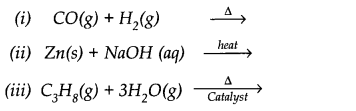
Which of the following reactions increases production of dihydrogen from synthesis gas?

Among NH3 H2O and HE, which would you expect to have highest magnitude of hydrogen bonding and why?
Which of the following statements are correct?
(a) Elements of group 15 form electron deficient hydrides.
(b) All elements of group 14 form electron precise hydrides.
(c) Electron precise hydrides have tetrahedral geometries.
(d) Electron rich hydrides can act as Lewis acids.
Hydrogen resembles halogens in many respects for which several factors are responsible. Of the following factors which one is most important in this respect?
(a) Its tendency to lose an electron to form a cation.
(b) Its tendency to gain a single electron in its valence shell to attain stable electronic configuration.
(c) Its low negative electron gain enthalpy value.
(d) Its small size.
When sodium peroxide is treated with dilute sulphuric acid, we get .
(a) sodium sulphate and water
(b) sodium sulphate and oxygen
(c) sodium sulphate, hydrogen and oxygen
(d) sodium sulphate and hydrogen peroxide.
Which of the following reactions is an example of use of water gas in the synthesis of other compounds?

(a) How is dihydrogen prepared from water by using a reducing agent?
(b) Give the industrial use of dihydrogen which depends upon heat liberated when it bums.
Hydrogen peroxide is obtained by‘the electrolysis of _______.
(a) water
(b) sulphuric acid
(c) hydrochloric acid
(d) fused sodium peroxide
Why does hydrogen occur in a diatomic form rather than in a monoatomic form under normal conditions?
If same mass of liquid water and a piece of ice are taken, then why is the density of ice less than that of liquid water?
Arrange the following:
(i) CaH2, BeH2 and TiH2 in order of increasing electrical conductance.
(ii) LiH, NaH and CsH in order of increasing ionic character.
(iii) H-H, D—D and F—F in order of increasing bond dissociation enthalpy.
(iv) NaH, MgH2 and H2O in order of increasing reducing property.
Explain the following:
(i) Temporary hardness can remove by boiling
(ii) Soft water lathers with soap but hard water not.
Which of the following equatibns depicts the oxidizing nature of H202?
(a) 2Mn0–4 + 6H+ + 5H202 → 2Mn2+ + 8H20 + 502
(b) 2Fe3+ + 2H+ + H202 → 2Fe2+ + 2H20 + 02
(c) 2I– + 2H+ + H202 → I2 + 2H20
(d) KI04 + H202 → KI03 + H20 + 02
What do you understand by the term ‘auto-protolysis of water? What is its significance?
Rohan heard that instructions were given to the laboratory attendant to store a particular chemical, i.e., keep it in the dark room, add some urea in it, and keep it away from dust. This chemical acts as an oxidizing as well as a reducing agent in both acidic and alkaline media. This chemical is important for use in the pollution control treatment of domestic and industrial effluents.
(i) Write the name of this compound.
(ii) Explain why such precautions are taken for storing this chemical.
Account for the following:
(i) dihydrogen gas is not preferred in balloons.
(ii) Cone. H2S04 cannot be used for drying H2.
Describe the bulk preparation of dihydrogen by electrolytic method. What is the role of an electrolyte in this process?
What do you understand by the term ‘auto-protolysis’ of water? what is its significance?
The oxide that gives H202 on treatment with dilute H2S04 is
(a) Pb02
(b) Ba02 -8H20
(c) Mn02
(d) Ti02
What do you understand by the term ‘non-stoichiometric hydrides’? Do you expect this type of hydrides to be formed by alkali metals? Justify your answer.
Saline hydrides are known to react with water violently producing fire. Can C02, a well known fire extinguisher, be used in this case? Explain.
Which of the following statement(s) is/are correct in the case of heavy water?
(a) Heavy water is used as a moderator in nuclear reactor.
(b) Heavy water is more effective as solvent than ordinary water.
(c) Heavy water is more associated than ordinary water.
(d) Heavy water has lower boiling point than ordinary water.
Some of the properties of water are described below. Which of them is/are not correct?
(a) Water is known to be universal solvent.
(b) Hydrogen bonding is present to a large extent in liquid water.
(c) There is no hydrogen bonding in the frozen state of water.
(d) Frozen water is heavier than liquid water.
Discuss the consequences of high enthalpy of H-H bond, in terms of chemical reactivity of dihydrogen.
Discuss the principle and method of softening of hard water by synthetic ion-exchange resins.
Write chemical reactions to justify that hydrogen peroxide can function as an oxidising as well as reducing agent.