

How will you distinguish between the following pairs of terms :
(a) Hexagonal close packing and cubic close packing
(b) Crystal lattice and unit cell
(c) Tetrahedral void and octahedral void.
(a) In hexagonal close packing (hcp), the spheres of the third layer are vertically above the spheres of the first layer
(ABABAB……. type). On the other hand, in cubic close packing (ccp), the spheres of the fourth layer are present above the spheres of the first layer (ABCABC…..type).
(b) Crystal lattice: It deplicts the actual shape as well as size of the constituent particles in the crystal. It is therefore, called space lattice or crystal lattice.
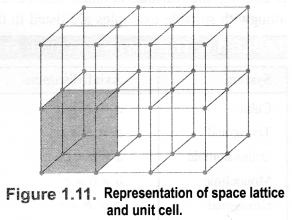 Unit cell: Each bricks represents the unit cell while the block is similar to the space or crystal lattice. Thus, a unit cell is the fundamental building block of the space lattice.
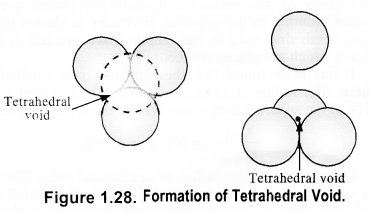
(c) Tetrahedral void: A tetrahedral void is formed when triangular void made by three spheres of a particular layer and touching each other.
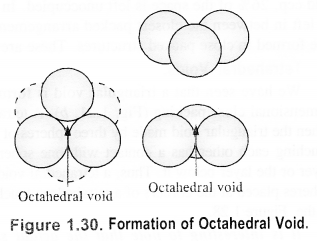
Octahedral void: An octahedral void or site is formed when three spheres arranged at the corners of an equilateral triangle are placed over anothet set of spheres.


Explain how vacancies are introduced in an ionic solid when a cation of higher valence is added as an impurity in it.
Classify each of the following as being either a p-type or n-type semiconductor :
Ionic solids, which have anionic vacancies due to metal excess defect, develop colour. Explain with the help of a suitable example.
Frenkel defect is also known as
(a) stoichiometric defect (b) dislocation defect
(c) impurity defect (d) non-stoichiometric defect
Gold (atomic radius = 0.144 nm) crystallises in a face centred unit cell. What is the length of the side of the unit cell ?
Classify the following as amorphous or crystalline solids: Polyurethane, naphthalene, benzoic acid, Teflon, potassium nitrate, cellophane, polyvinyl chloride, fibreglass, copper
In which of the following arrangements octahedral voids are formed?
(a) hep (b) bcc (c) simple cubic (d) fee
If the radius of the octahedral void is r and radius of the atoms in close-packing is R, derive relation between rand R.
Cations are present in the interstitial sites in
(a) Frenkel defect (b) Schottky defect
(c) vacancy defect (d) metal deficiency defect .
The number of tetrahedral voids per unit cell in NaCl crystal is
(c) twice the number of octahedral voids
(d) four times the number of octahedral voids
Classify each of the following solids as ionic, metallic, modular, network (covalent) or amorphous:
(i) Tetra phosphorus decoxide (P4O10) (ii) Ammonium phosphate, (NH4)3P04 (iii) SiC (iv) I2 (v) P4 (vii) Graphite (viii), Brass (ix) Rb (x) LiBr (xi) Si
Niobium crystallises in a body centred cubic structure. If density is 8.55 g cm-3, calculate atomic radius of niobium, using its atomic mass 93u.
Copper crystallises into a fee lattice with edge length 3.61 x 10⁻⁸ cm. Show that the calculated density is in agreement with its measured value of 8.92 gcm-3.
Which of the following is not the characteristic of ionic solids?
(a) Very low value of electrical conductivity in the molten state
(b) Brittle nature
(c) Very strong forces of interactions
(d) Anisotropic nature
Explain how many portions of an atom located at
(i)corner and (ii)body centre of a cubic unit cell is part of its neighbouring unit cell.
Ionic solids, which have anionic vacancies due to metal excess defect, develop colour. Explain with the help of a suitable example.
Ferric oxide crystallises in a hexagonal dose- packed array of oxide ions with two out of every three octahedral holes occupied by ferric ions. Derive the formula of the ferric oxide.
The total number of tetrahedral voids in the face centered unit cell is
(a) 6 (c) 10
(b) 8 (d) 12
An excess of potassium ions makes KCl crystals appear violet or Lilac in colour since
(a) some of the anionic sites are occupied by an unpaired electron
(b) some of the anionic sites are occupied by a pair of electrons
(c) there are vacancies at some’anionic sites
(d) F-centres are created which impart colour to the crystals
Why does the electrical conductivity of semiconductors increase with rise in temperature?
Assertion (A): Semiconductors are solids with conductivities in the intermediate range from

Reason (R): Intermediate, conductivity in semiconductor is due to partially filled valence band.
A sample of ferrous oxide has actual formula Fe0.93 O1.00. In this sample, what fraction of metal ions are Fe2+ ions? What is the type of non-stoichiometric defect present in this sample? '
Copper crystallises into a fee lattice with edge length 3.61 x 10⁻⁸ cm. Show that the calculated density is in agreement with its measured value of 8.92 gcm-3.
A compound forms hexagonal close-packed. structure. What is the total number of voids in 0. 5 mol of it? How many of these are tetrahedral voids?
What type of defect can arise when a solid is heated? Which physical property is affected by it and in what way?
Silver crystallises in fcc lattice. If edge length of the cell is 4.07 x 10⁻⁸ cm and density is 10.5 g cm-3, calculate the atomic mass of silver.
Which of the following is not true about voids formed in three dimensional hexagonal close packed structure?
(a) A tetrahedral void is formed when a sphere of the second layer is present above triangular void in the first layer
(b) All the triangular voids are not covered by the spheres of the second layer
(c) Tetrahedral voids are formed when the triangular voids in the second layer lie above the triangular voids in the first layer and the triangular voids in the first layer and the triangular shapes of these voids do not overlap
(d) Octahedral voids are formed when the triangular voids in the second layer exactly overlap with similar voids in the first layer.
Which of the following statements are true about semiconductors?
(a) Silicon doped with an electron rich impurity is a p-type semiconductor
(b) Silicon doped with an electron rich impurity is an n-type semiconductor
(c) Delocalised electrons increase the conductivity of doped silicon
(d) An electron vacancy increases the conductivity of type semiconductor
Which of the following features are not shown by quartz glass?
(a) This is a crystalline solid
(b) Refractive index is same in all the directions
(c) This has definite heat of fusion
(d) This is also called super cooled liquid
Which of the following cannot be regarded as molecular solid?
(a) SiC (b) AIN
(c) Diamond (d) I2
Wh ich of the following lattices has the highest packing efficiency (i) simple cubic (ii) body-centered cubic and (iii) hexagonal close-packed lattice?
A group 14 element is to be converted into n-type semiconductor by doping it with a suitable impurity. To which group should this impurity belong?
Explain the following with suitable example:
A group 14 element is to be converted into n-type semiconductor by doping it with a suitable impurity. To which group should this impurity belong?
What type of substances would make better permanent magnets, ferromagnetic or ferrimagnetic. Justify your answer.
How will you distinguish between the following pairs of terms:
(i) Cubic close packing and hexagonal close packing?
(ii) Crystal lattice and unit cell?
(iii) Tetrahedral void and octahedral void?
How many lattice points are there is one unit cell of each of the following lattices?
(i) Face centred cubic (if) Face centred tetragonal (iii) Body centred cubic
Calculate the efficiency of packing in case of a metal crystal for (i) simple cubic, (ii) body centred cubic, and (iii) face centred cubic (with the assumptions that atoms are touching each other).
A cubic solid is made up of two elements P and Q. Atoms of Q are at the corners of the cube and P at the body centre. What is the formula of the compound? What are the coordination numbers of P and Q?
What is the coordination number in a square close packed structure in two dimensions? (a) 2 (b) 3 (c) 4 (d) 6

